

Insiders Buy Their Own Stock Every Spring. Watch the One Who Suddenly Buys in November.
The Big Short 2026, Part 2. 1,777 insider purchases, one calendar test, and a 5.3-point gap that fourteen years of publicity still hasn't closed.
 By Sepehr Parsa · Founder and editor, WallStPal
Every March, like clockwork, a certain kind of executive buys a little more of their own company's stock. You could set your calendar by it. And according to a well-known study and the 1,777 purchases I just tested, you can ignore almost every one of those buys.
The buy worth your attention is the one that breaks the habit.
In Part 1 of this series I argued that insider buying matters and insider selling mostly doesn't. This part goes back to buying, and to a problem hiding inside it.
A lot of insider purchases aren't decisions at all. They're habits.
The trick that fits on a napkin
In 2012, three researchers, Lauren Cohen, Christopher Malloy and Lukasz Pomorski, published a paper in the Journal of Finance called "Decoding Inside Information." Their idea was simple enough to fit on a napkin.
Look at each insider's own history. If someone has traded in the same calendar month for several years in a row, every March for example, call them a routine trader. Their trades follow a calendar, not a view about the company. Bonuses get paid, trading windows open, and the trade happens.
Everyone else with enough history is an opportunistic trader. They trade when they decide to, and the timing is the information.
The gap they found was large. Routine trades predicted essentially nothing. A portfolio built on opportunistic trades earned about 0.82% a month above the market, value-weighted, and about 1.8% a month equal-weighted. Opportunistic trades also came before company news, like earnings surprises, while routine trades did not.
There was one more finding that I think about a lot. Opportunistic trading was linked to a higher chance of SEC enforcement later. Routine trading was not.
Fourteen years later, does it still work?
Fourteen years is a long time for a published edge to survive. Once everyone knows a trick, it usually stops working. So I ran the same split on the insider purchases in the WallStPal database.
The rule I used: an insider who traded in each of the last three years is routine if they also traded in this same calendar month in each of those years, and opportunistic if they didn't. Anyone without three years of history is left unclassified. The trading history comes from SEC Form 4 filings and the SEC's quarterly insider data sets.
Then I measured each purchase the same way every time: the stock's return over the next three months, minus the S&P 500's.
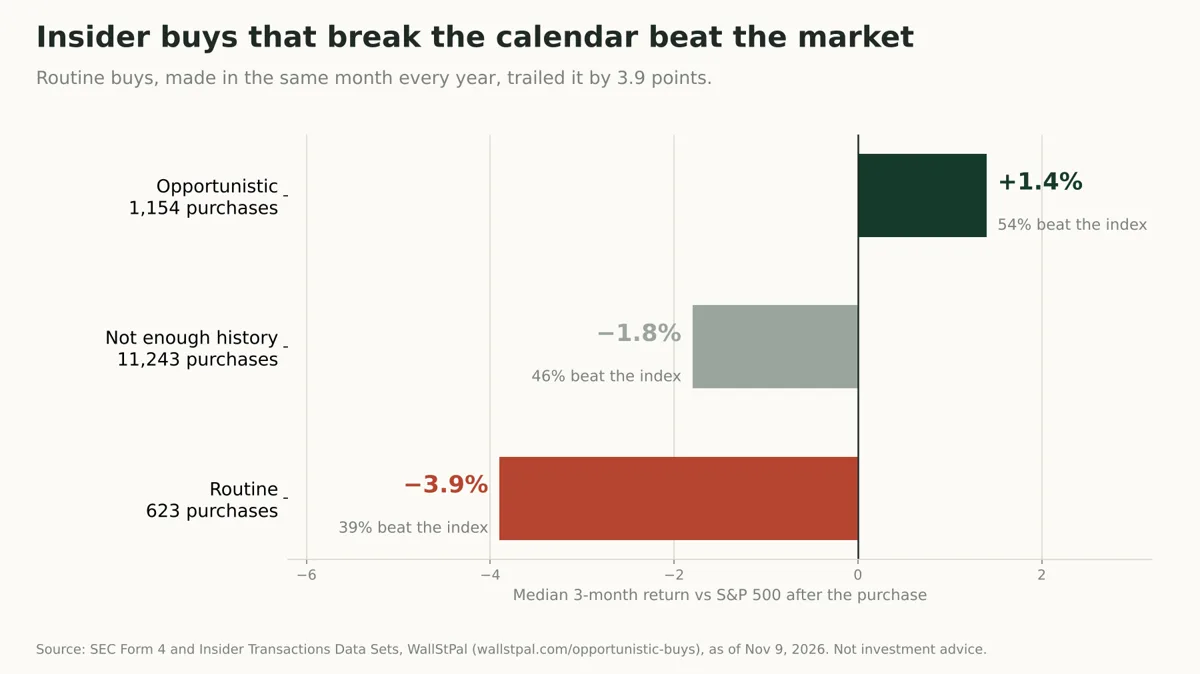
| Kind of purchase | Purchases | Median vs S&P 500, 3 months | Beat the index |
|---|---|---|---|
| Opportunistic | 1,154 | +1.4% | 54% |
| Not enough history | 11,243 | −1.8% | 46% |
| Routine | 623 | −3.9% | 39% |
Data as of Nov 9, 2026. The same table, updated every day, is on our opportunistic buys page.
Update, November 14, 2026. Since this was written our data has grown: recent weekly prices now cover many more stocks, so close to three times as many opportunistic purchases can be measured. On the larger sample the gap between the two groups still holds, but it is smaller and the level has moved: opportunistic purchases trail the S&P 500 by a median 0.9 points and routine ones by 5.3. Breaking the calendar still beats keeping it; on its own, it no longer beats the index. The live numbers are on the opportunistic buys page.
The split still works. Opportunistic purchases beat the market by a median of 1.4 points. Routine purchases trailed it by 3.9 points. That's a gap of 5.3 points between two groups of people doing what looks like the same thing: buying their own company's stock.
The routine number is the surprising one. Not only did routine buys fail to beat the market, they did worse than the purchases we couldn't classify. Buying on a schedule is not a signal of anything.
One honest note on the selling side. The same split barely matters for sales: opportunistic sales were followed by −2.5% against the market, routine sales by −3.7%. Selling stays noisy however you slice it.
Spot one yourself with two questions
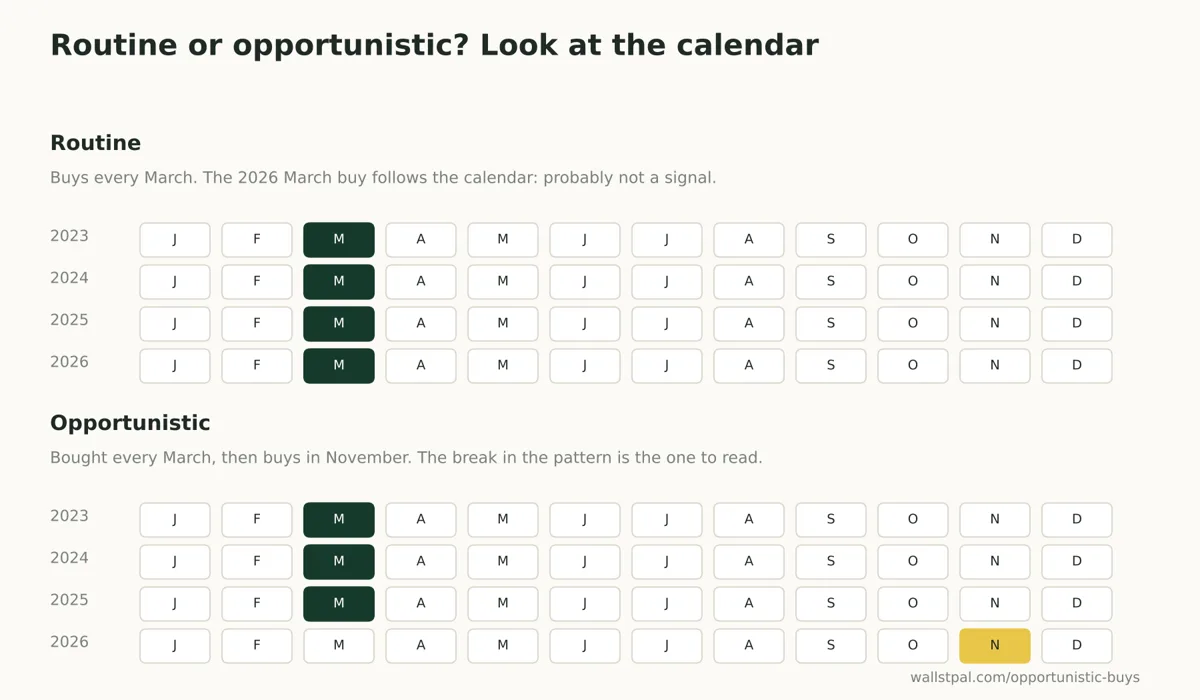
You don't need software for this. Open an insider's filing history on the SEC's EDGAR site or on WallStPal and ask two questions.
- Has this person traded every year? If they only bought once, ever, you can't tell routine from opportunistic. That's most insiders.
- Do the trades bunch in the same month? If they bought in March of 2023, 2024 and 2025, and this purchase is in March again, it's probably routine. If they bought in March three years running and now they're buying in November, that's the one to read.
Who was breaking the calendar in November 2026
The opportunistic purchases filed in the months before this article are a mixed bag, and it's worth being honest about why.
A large part of the list is not executives at all. It's funds that own 10% or more of a company, or that have a partner on its board. Berkshire Hathaway bought about $400 million of Lennar stock over seven trading days in late September. Baker Bros. bought Kodiak Sciences and Madrigal Pharmaceuticals. OrbiMed and RA Capital bought into several young biotech companies where they have a partner on the board, which often looks more like financing than a view on the price. A fund has its own reasons and its own calendar, so a fund on this list deserves a different reading than a CEO.
The executive purchases are the ones closest to what the research measured:
- Uber (UBER). CEO Dara Khosrowshahi bought $10.0 million of stock on September 10, 2026.
- Intel (INTC). CEO Lip-Bu Tan bought $10.0 million on August 11, 2026 and another $9.7 million on November 2.
- MGM Resorts (MGM). Director Keith Meister bought $51.5 million on October 30, 2026.
None of these was old enough for the three-month test when this was written, so this is a list to watch, not a scorecard. Their results appear on each stock's page as the months pass.
The quiet buyer who may know more than the CEO
The research found the most informative opportunistic traders were often not the CEO. They tended to be less senior insiders, at companies near where they lived, with weaker governance. A $10 million CEO purchase gets the headlines. A $200,000 purchase by a regional vice president who has never bought in that month before may say more.
The gap between opportunistic and routine buys is a median. Plenty of opportunistic purchases lost money: 46% of them trailed the market. One trade, however well timed it looks, can still go wrong. This is research, not investment advice.
The live list, with the track record updated every day, is at wallstpal.com/opportunistic-buys. There's a longer explainer in our guide to opportunistic insider trading.
Sources
- WallStPal: opportunistic insider buying, data as of November 9, 2026
- Cohen, Malloy and Pomorski, "Decoding Inside Information," Journal of Finance, 2012 (summary)
- SEC Form 4 filings and the SEC Insider Transactions Data Sets
Built from SEC Form 4 and 13F filings and STOCK Act reports as read by WallStPal, rebuilt every day. Prices are weekly closing prices; see our method for where they come from. Results describe what stocks did, not anyone's profit, and are not investment advice. See our method.
About this page
WallStPal explains public SEC filings and congressional stock trade reports in plain English. Nothing is for sale; the site is free and supported by ads.
How to read it
- Form 4
- The form a company insider (officer, director or owner of more than 10%) must file with the SEC within two business days of buying or selling the company's shares.
- 13F
- A quarterly list of U.S. stocks held by an investment manager with more than $100 million, filed within 45 days after each quarter ends.
- STOCK Act
- A 2012 law that requires members of Congress to report stock trades by themselves, a spouse or a dependent child within 45 days.
A real example
In January 2016, when bank stocks were falling, JPMorgan Chase CEO Jamie Dimon bought 500,000 JPMorgan shares with his own money, worth about $26 million. His Form 4 made the purchase public within days, and investors read it as a strong sign of confidence.
Explain it like I'm 13
We read the long, boring forms that grown-ups file with the government and tell you what they say in normal words.
Data from public SEC filings and congressional reports. Information, not investment advice. Check every number against the filing linked on the page.